The Signal Over the Noise: Meet Macro Lens — the Whole Market, Read in 5 Minutes a Day
A free, five-minute daily brief that reads thirteen market sensors the way a Wall Street desk does — and answers the only question that matters at 8 a.m.: should you be worried?
Lindsay Hiebert, Founder · July 18, 2026 · 7 min read

Investors, analysts, brokers, CFAs — lend us your ears, your hearts, and your minds for a couple of minutes each day. If you come to rely on what follows, do the thing that keeps it alive: don't settle for the free tier. Go PRO, or become a Founding Member, and back independent work built to make you a more effective investor — not merely a faster one.

Caption: The whole idea in one image — the noise is abundant, but only the signal reaches the instrument.
Every single day, the modern investor is asked to run a gauntlet of emotional manipulation.

Caption: The daily gauntlet — a corridor of noise, and one quiet way through it.
Open any financial news app, check a social feed, or turn on cable business news, and you are met by a relentless stream of sensationalism. Headlines compete for your finite attention using panic, hyperbole, and manufactured urgency. A 1% dip in a major index is framed as an impending collapse; a routine interest-rate remark is analyzed with the intensity of a geopolitical crisis.
This is the financial outrage economy. It runs on an engagement-driven business model where clicks matter more than clarity and speed outranks substance. The result is that the modern information ecosystem doesn't inform investors — it gives them anxiety. It pushes otherwise rational people into hyper-reactivity, and that leads to emotional decisions, over-trading, and a low-grade exhaustion that never quite goes away.
Fast is not the same as effective

Caption: The outrage machine is exquisitely efficient — at producing the wrong thing.
Peter Drucker drew a distinction that every investor should tape to the wall: efficiency is doing things right; effectiveness is doing the right things. "There is nothing so useless," he wrote, "as doing efficiently that which should not be done at all."
The financial media complex is optimized for efficiency. It will get a reaction out of you faster than anything humans have ever built. But reacting quickly to the wrong signal is not a virtue — it's how portfolios get damaged. It does not matter how quickly you do the wrong thing. A worry-driven sale that shouldn't have happened, a disciplined plan broken on a Sunday-night headline, years of compounding interrupted by a panic — those are the real costs of self-directed investing, and none of them come from being slow.
Macro Lens is built for effectiveness, not for speed. We built it to change what you react to.
The real question: "Should I be worried?"
When the noise reaches a crescendo, a self-directed investor — a surgeon, an engineer, a retiree managing her own accounts — isn't actually asking "which stock should I day-trade today?"

Caption: The one question underneath all the others — asked calmly, answered with data.
They're asking something more foundational: "Should I be worried?"
They want to know whether the structural foundations of the market are shifting. Whether a scary headline is transient noise or a genuine change in the macroeconomic regime. Whether it's a day to do nothing — which is most days — or one of the rare days that actually calls for attention.
Traditional financial media can't answer that, because it treats every data point with the same undifferentiated alarm. If everything is a crisis, nothing is.
Macro Lens exists to answer that one question honestly. Think of it as GPS for your portfolio: most days it says "continue straight — you don't need to worry, and here's why," and on the rare day the road actually changes, it tells you plainly.
What you get every morning

Caption: Today's Read and The Morning Tape — the day's macro weather, before the open.
Macro Lens opens up in stages, and the most important layer is free, forever:
- Today's Read — the free daily brief. The day's regime call in plain English: what's actually moving, and the headline most likely to worry you, decoded against the data. Read it on the site anytime, no account needed; sign up for the free newsletter and it arrives each weekday morning with the last two weeks of the archive.
- The Morning Tape — a pre-market note for members, twice a morning before the open: the "dawn weather" of what moved overnight and what it might mean, in a few plain sentences.
- The Regime Board — every one of the thirteen sensors, each with its full flip history, so you can see not just today's state but every time it changed.
- The "Should I worry?" tool — paste any market headline and get a calm, engine-grounded take in about fifteen seconds.
The daily brief is the load-bearing promise: it stays free regardless of whether you ever pay. The member features exist only to keep it that way.
The value: a PhD in macro, in your palm

Caption: The macro layer the professionals read first — the thing the day's ticker can't show you.
Here is the honest comparison. A Bloomberg terminal costs roughly $32,000 a year. A staff macro economist to interpret it for you is a six-figure salary. A wealth advisor will read the macro for you in exchange for 1% of your assets, every year, forever. All three are buying the same thing: a calibrated read of where the market actually is, delivered by someone who knows how to read the instruments.
Macro Lens is that read — the large money flows that decide whether the whole market is leaning risk-on (confident) or risk-off (defensive) — distilled into five minutes and plain English, for free. It is, quite deliberately, a PhD in macroeconomics in the palm of your hand: not more data, but data organized so a common investor can understand it and act on it effectively.
The reason this is possible now is simple: the calibrated synthesis that used to require a terminal and an analyst's morning has, in the last couple of years, become inexpensive enough to give to everyone. The context Wall Street has always had — now for the rest of us.
What it reads: thirteen sensors, three questions
Every morning, before a single word is written, Macro Lens classifies thirteen market sensors — all built from free, public data anyone can reproduce. They're organized into the same three plain-English groups you see on the live board, and each group answers one question.

Caption: Risk Appetite — which parts of the market are leading, and which are quietly stepping back.
Risk Appetite — bold or defensive? Four fast "rotation" sensors read whether capital is leaning into risk or hiding from it: are chips leading the market (confidence in the forward economy), is the consumer spending on wants or only needs, are investors rewarding lenders or hiding in safe-yield utilities, is the rally broad or dangerously top-heavy? This is the fast read on the market's mood.

Caption: Early Warning Signs — look beneath the surface, where stress shows up first.
Early Warning Signs — is anything cracking? These sensors watch where trouble appears first: the credit market — the single most important tell, because credit usually sees problems weeks before stocks do — plus energy pressure, the price of oil, and the Brent–WTI spread that separates a real physical-supply shock from a fear-driven price spike. When these are calm, a rally has a foundation. When they crack, you want to know early.

Caption: The Big Picture — the slow dials that set the conditions everything else moves inside.
The Big Picture — rates, inflation & the dollar. Three slow macro dials — the yield curve, inflation expectations, and the trade-weighted dollar — frame the environment. They shift rarely, which is exactly why it matters for years when they do.
Six of the thirteen — the fast rotation sensors — combine by a simple, published count into one calibrated call: all clear, mostly clear, some caution, cautious, or mixed signals, each with a confidence level. (Those six are the four Risk Appetite dials plus two from Early Warning — credit conditions and energy pressure.) The other seven describe the weather they're moving through. That single call is the answer; everything else in the brief explains why it is what it is.
The methodology that keeps it honest

Caption: Three commitments, one standard — objectivity, brevity, and a read you can verify.
The framework rests on three commitments. Objectivity over hype: the math leads and the writing follows — a deterministic engine makes the call, and the language can never contradict it. If the engine says mostly clear, the brief never says imminent recession; that's a bug, not a flourish. The five-minute rule: we do the heavy lifting — reading the same thirteen instruments the same way every day and stripping the fluff — and hand you the small amount that matters. Verifiable, not trust-me: the engine is the integrity layer. Every claim traces back to free public data — when the brief says credit is accepting risk, that maps to a specific, reproducible signal you can check yourself. The full methodology is published, versioned, and auditable; a subset of briefs also carry a "Founder Reviewed" badge confirming the pipeline held. Nothing here is a black box.
Calm is not the absence of information
The best investors aren't the ones who react fastest to new information. They're the ones who stay effective — who keep their clarity when everyone else is panicking. That takes an anchor: an early warning system that stays quiet when there's nothing to fear and speaks up precisely when the structural conditions actually change.

Caption: That anchor is Macro Lens. Calm isn't the absence of information — it's information with the noise removed.
Free for everyone — kept alive by members
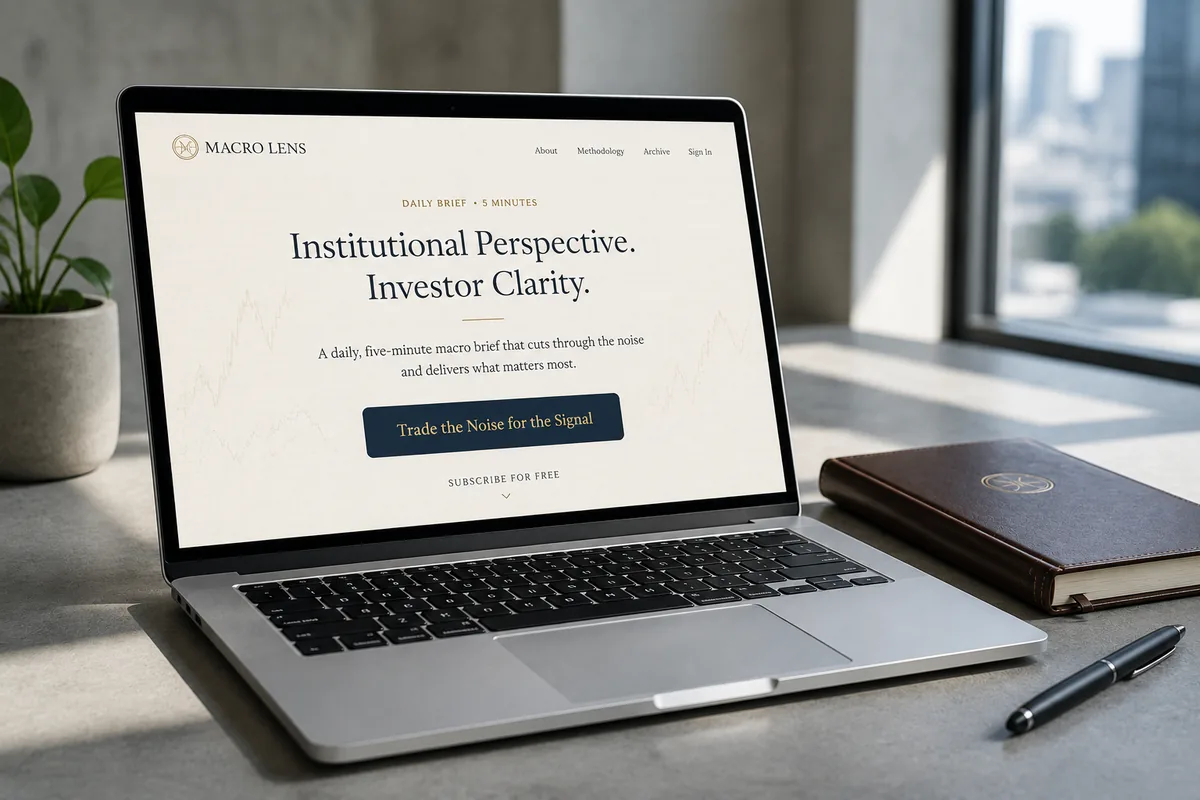
Caption: Today's Read is free — five minutes every morning, the same public data, read the same calibrated way.
Here is the part we're proudest of. Today's Read — the daily brief — is free for everyone, forever. No paywall, no trial, no credit card. A paywall on the daily brief would defeat the entire purpose. Macro Lens was built in the spirit of AI for Good: the moment frontier AI made institutional-grade macro synthesis affordable, the right thing to do was to hand it to the people who never had access — not to lock it behind a terminal.
So the model is simple, and a little old-fashioned. The brief is free. Members keep it that way. If Macro Lens makes your mornings calmer and your decisions more effective, you can support the work — and get the whole platform in return:
- Monthly Supporter — $14/month. Unlocks The Morning Tape, the full Regime Board with every sensor's flip history, the complete archive back to day one, and the "Should I worry?" tool. Cancel anytime.
- Founding Member — $99/year. Everything above, plus a locked-in founding rate, a numbered founder badge, and a permanent place in the record — reserved for the first 100 readers who choose to back the work early.
And here's the honest ask, plainly. Free isn't free to build. If this earns a place in your morning, put your money where your heart is. Don't just "like" it and ride along in the passenger seat — a publication kept alive entirely by free riders doesn't stay alive. The readers who become Monthly Supporters and Founding Members are the ones who decide whether independent, founder-built work like this exists at all. If you value it, be one of them.
This isn't buying access to a gate. It's keeping the gate open for the next person — patronage of a small, serious publication, in the tradition of the memos and letters that were always free to read and always felt like a privilege to receive.
Read today's brief free at getmacrolens.com. Then, if it serves you, become a member — put your money where your heart is, and keep it free for everyone else.
Macro Lens is a financial publication. We provide general market commentary and analysis based on public information. Nothing in our content constitutes investment advice, a recommendation to buy or sell any security, or an offer of investment advisory services. Past performance does not predict future results. Markets carry risk of loss. Before making investment decisions, consult a licensed financial professional who can evaluate your specific situation.
Get the five-minute brief every weekday morning.
Free, forever. Calm by default — plain English, no jargon, no urgency.
Macro Lens is a financial publication, not investment advice. Nothing herein is a recommendation to buy or sell any security. The methodology is published and reproducible from public data.